I was super excited to purchase my first GoMining AI Miner today. I wanted to take you through the entire purchasing process, show you how everything works and start sharing my daily earnings with you.
Unfortunately, that’s not what we’re doing today.
After spending time going through the numbers, reading the legal agreements and communicating with my VIP manager, I have some serious questions about the product. In this GoMining AI Miner review, I want to explain exactly why I’ve decided to hold off on making that purchase.
We’re looking at a $249.99 AI Miner that, based on the advertised annual ROI figures from my research, is projected to return approximately $183 after estimated maintenance over the first three-year buyer contract. At that point, we’re still approximately $66 to $67 short of recovering our purchase price.
So when do we actually start making money? That’s what I’m trying to figure out!
On a more positive note, our NFT Miner CA clan is having an encouraging start to Cycle 171. We’ve got some new members, some great participation and a big x32 win to celebrate. There’s plenty to talk about today.
In This Review
What Is a GoMining AI Miner?
On November 24, 2026, GoMining introduced AI Miners, giving us another way to participate in the growing demand for NVIDIA GPU computing power.
If you’re familiar with GoMining’s Bitcoin miners, you already know that we purchase mining power measured in terahashes, or TH. With AI Miners, we’re purchasing access to computing power measured in teraflops, or TF.
There is an important difference, though. We’re not purchasing a physical GPU, and we’re not purchasing the same type of NFT asset that we receive with our Bitcoin miners.
We’re purchasing access to computing power for a specified period of time. GoMining refers to this as our Service Term.
Once we’ve created our AI Miner, we can select an available compute buyer contract. That’s the agreement that allows us to earn income from our computing power.
Two of the initial buyer offers come from NEAR AI and Gcore. Both offer three-year contracts with daily payouts in USDC. An active buyer contract is required to generate earnings.
It sounds interesting, and that’s exactly why I wanted to get involved. But before we start spending money, I think it’s important to understand what we’re actually purchasing and how much we can reasonably expect to earn.
You can read the official GoMining AI Miner announcement and explore the AI Miner product page.
GoMining AI Miner Review: Breaking Down the Numbers
Let’s use the 10.70 TF AI Miner that I’ve been looking at as our example. In my November 24 and 25 research, I noted a purchase price of US$249.99 and two buyer offers, one from NEAR AI and one from Gcore.
One thing I wanted to clarify with my VIP manager was whether the advertised daily earnings included maintenance expenses.
The daily earnings are displayed before maintenance. However, the advertised annual ROI is calculated using the estimated daily earnings after maintenance.
That distinction is extremely important because it changes how much of our original purchase price we can expect to recover.
The calculation is also explained in GoMining’s official AI Miner FAQ.
NEAR AI Versus Gcore: Three-Year Financial Comparison
| Financial breakdown | NEAR AI | Gcore |
|---|---|---|
| Computing capacity | 10.70 TF | 10.70 TF |
| Purchase price | $249.99 | $249.99 |
| Buyer contract | 3 years | 3 years |
| Advertised annual ROI | 24.4% | 24.5% |
| Daily gross earnings | 0.2140 USDC | 0.2169 USDC |
| Estimated daily maintenance | $0.0469 | $0.0491 |
| Estimated daily net earnings | $0.1671 | $0.1678 |
| Illustrative payout days | 1,095 | 1,095 |
| Estimated gross earnings | $234.33 | $237.51 |
| Estimated maintenance expenses | $51.34 | $53.76 |
| Estimated net earnings | $182.99 | $183.74 |
| Unrecovered purchase cost | $67.00 | $66.25 |
| Purchase cost recovered | 73.2% | 73.5% |
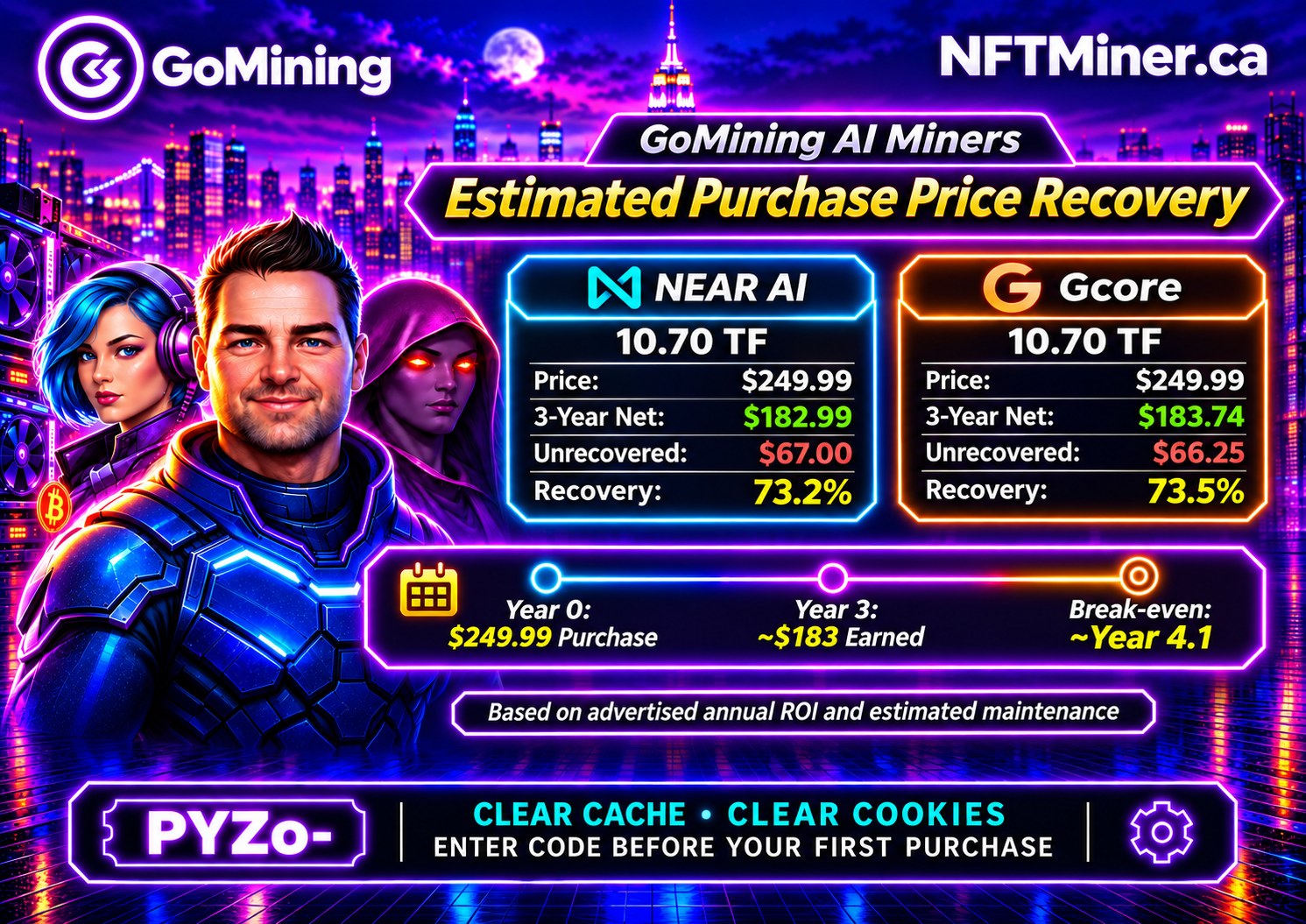
Look at those final two numbers. Even if we receive all the expected payments and our estimated maintenance expenses remain the same, neither example recovers its purchase price in the first three years.
That’s what I was referring to when I discussed being approximately $60 to $70 short in today’s video.
For the NEAR AI contract, we’re recovering approximately 73.2% of our purchase price. With Gcore, we’re recovering approximately 73.5%.
Under either of these projections, I’m not celebrating a profit after three years. I’m still trying to get my original investment back!
Understanding the Advertised Annual ROI
The advertised annual ROI for NEAR AI is 24.4%. Here’s how that translates into estimated earnings over the initial three-year buyer contract.
- Original purchase price: $249.99.
- Estimated annual net earnings: $249.99 × 24.4%.
- Estimated three-year net earnings: $249.99 × 24.4% × 3 = $182.99.
- Unrecovered purchase price: $249.99 minus $182.99 = $67.00.
Using the same calculation for Gcore, we’re left with approximately $66.25 of our original investment unrecovered.
Now, that doesn’t necessarily mean we’ve lost that money permanently. If we’re able to accept additional buyer contracts after those three years, we could continue earning income without purchasing another AI Miner.
But that’s where things start getting complicated.
When Would We Actually Start Making Money?
If we could continue earning at the same estimated daily net rate after our original buyer contract expires, here’s approximately how long it would take to recover the purchase price.
| Estimated break-even comparison | NEAR AI | Gcore |
|---|---|---|
| Initial buyer contract | 3 years | 3 years |
| Illustrative break-even period | 4.10 years | 4.08 years |
| Additional earning time required | Approximately 13 months | Approximately 13 months |
We’re talking about more than four years just to get our original purchase price back, assuming the income continues at the same rate.
Before I can even begin to consider that possibility, I need to know whether I’m purchasing access to computing power for more than four years.
Open the interactive calculator in a separate tab.
Five Questions From My GoMining AI Miner Review
1. What Is Our Actual AI Miner Service Term?
This is the biggest question I have right now.
When we purchase an AI Miner, we’re entering into a service agreement. When we select a buyer, we’re entering into a separate buyer contract.
These are not the same thing!
| Agreement | What it means | Duration |
|---|---|---|
| AI Miner Service Term | How long we have access to our purchased computing power. | Not yet confirmed |
| Compute Buyer Contract | How long a buyer agrees to use our computing power under an established rate. | 3 years for the current offers |
I’ve gone through GoMining’s Terms of Use, including Section 8.9, which explains that an AI Miner is a computing service for a fixed Service Term. It also refers to a separate AI Miner User Agreement that governs the full conditions of the product.
The legal documentation refers to a Lot Specification. I have not been able to establish the actual Service Term for the AI Miner I was considering purchasing.
But where is that Lot Specification? Where can I actually see how long I’m purchasing this computing service for?
I’ve reached out to my VIP manager, and he’s currently looking into it for me.
What is our Service Term, and where can we review the Lot Specification before purchasing an AI Miner?
Is it three years? Is it five years? Is it six years?
It doesn’t matter whether we’re purchasing 10.70 TF or a substantially larger AI Miner. We still need to know how long we’re entitled to use that computing power.
I can’t work out the profitability of something when I don’t know how long I’m purchasing it for.
2. What Happens After Our Three-Year Buyer Contract Expires?
One thing we’ve been able to clarify is that we don’t necessarily have to purchase another AI Miner when our first buyer contract expires.
We can accept another buyer contract, provided we still have an active Service Term.
That’s encouraging. But let’s use five years as an example. I’m not saying our Service Term is five years because that hasn’t been confirmed.
If we had a five-year Service Term beginning at the same time as the first buyer contract, we would potentially have two years of computing service remaining after that contract expires.
At that point, we would need to find another buyer. We would need a contract that fits within our remaining service duration, and we would need that contract to provide enough income to recover our outstanding investment.
What happens if there isn’t another buyer available?
According to the FAQ, an idle AI Miner doesn’t generate income or incur the maintenance charges associated with an active buyer contract. Our original purchase price also isn’t refunded simply because a buyer contract has ended.
So we could potentially be sitting there with computing power that isn’t generating any income.
If our Service Term is long enough, if another buyer is available, if the new contract fits within our remaining service duration and if the earnings are sufficient, we might eventually make money.
That’s way too many ifs for me right now.
3. Will Our Computing Power Still Be Competitive in Three Years?
Three years is a long time when we’re talking about technology.
Are we confident that the GPU computing power we’re purchasing today will still be desirable in three years? Are we confident that buyers will be prepared to pay the same rates?
Technology is constantly developing. Newer hardware could offer better performance and improved energy efficiency.
One of the things I love about my Bitcoin miners is that I can upgrade their power and efficiency. AI Miner power upgrades aren’t currently available.
GoMining has discussed additional AI-related features, including personal computing use, but those aren’t opportunities I can include in my calculations today.
I’m not saying the computing power will become obsolete. I’m asking whether we have enough information to make a financial decision that extends beyond the initial three-year contract.
4. What Will We Actually Earn After Maintenance?
One of the appealing aspects of these buyer contracts is that we have an established gross earning rate.
But as we’ve already seen with the NEAR AI and Gcore examples, that isn’t the amount we’re necessarily keeping.
We still have electricity and service expenses. GoMining’s product page identifies electricity at $0.05 per kWh, along with a separate service charge based on our computing power.
We can also benefit from applicable GOMINING token maintenance discounts and VIP benefits. Eligible direct AI Miner purchases contribute towards VIP qualification, with one TF counting equivalently to one TH for that purpose. That does not mean one TF and one TH have the same earning potential or financial value.
I do like seeing those features incorporated into the AI Miner product.
Anyone who’s been following my content knows how much time I’ve spent trying to fund my Bitcoin mining maintenance expenses through other income sources within GoMining.
If I’m going to add AI Miners to my portfolio, I need to know how much more maintenance I’ll be responsible for.
We also have to consider what happens if a buyer stops paying or ends a contract early. GoMining does not guarantee replacement payments from its own funds.
There is another detail in the AI Miner risk disclosure in GoMining’s Terms of Use (Exhibit A, Section 10). The service fee remains payable while a compute contract is active, even if the buyer payments are insufficient. Future buyer offers could also pay less than the applicable service fee. The FAQ says we cannot simply switch buyers while an existing contract is active.
That’s something I want to understand before accepting a contract. A fixed gross rate does not guarantee the amount we’ll actually receive.
My calculations assume we receive all the expected payments over the three years and that our estimated net earning rates remain unchanged. That’s our starting point for evaluating the product, not a guarantee of what we’ll receive.
5. What Happens If I Want to Sell My AI Miner?
I’ve seen discussions within the GoMining community about purchasing an AI Miner and simply selling it later.
But let’s think about that for a minute.
If I purchase an AI Miner for $249.99 today and another customer can create a brand-new one for the same price, what would encourage them to purchase mine?
The remaining Service Term, buyer contract and future earnings could certainly influence its value. But I can’t assume I’ll recover the entire original purchase price by selling it.
There’s also something I want to see clarified within GoMining’s documentation.
- The AI Miner FAQ describes selling AI Miners through the secondary marketplace, including the transfer of active buyer contracts.
- The AI Miner product page describes resale as a future feature and indicates that miners with active contracts cannot currently be sold.
- Section 8.9.5 of the Terms of Use makes resale conditional on the functionality being available.
Until we have clarification on that, I’m not going to include a resale value in my GoMining AI Miner review.
GoMining AI Miners Versus Bitcoin Miners
I’ve been mining Bitcoin with GoMining for approximately three years now, and one of the things I’ve really enjoyed is the flexibility we have within the ecosystem.
We can upgrade our miners, improve their efficiency, participate in Miner Wars, explore governance locks and purchase or sell digital miners through the marketplace.
Those are all things I’ve been able to explore through my own account and share with you.
| Feature | Bitcoin Miner | AI Miner |
|---|---|---|
| Power measurement | TH | TF |
| Earnings | Bitcoin | USDC |
| Earning rate | Variable | Fixed buyer rate, subject to deductions and contract performance |
| Miner Wars | Available | Unavailable |
| Power upgrades | Available | Unavailable at launch |
| Efficiency upgrades | Available | Not established |
| VIP qualification | Eligible TH | Eligible TF |
| Maintenance discounts | Available | Available under applicable conditions |
| Instant Funds | Available for eligible assets | Unavailable at launch |
| Reinvestment target | Available for eligible miners | Unavailable at launch |
| Purchase structure | Digital miner NFT | Fixed-term computing service |
| Separate compute buyer contract | Not required | Required to generate buyer earnings |
| Secondary marketplace | Established | Requires clarification |
| Ambassador commissions | Eligible purchases | Eligible purchases |
Why I Prefer Accumulating Bitcoin
Another thing that really stands out to me is that we’re receiving USDC from these AI Miner contracts.
USDC is a stablecoin designed to maintain a value close to one US dollar. That’s useful, but it’s not designed to increase in value over time.
My personal goal is to accumulate Bitcoin. I want to earn satoshis today and potentially benefit from their future value.
Will Bitcoin always increase in value? Absolutely not. We know how volatile Bitcoin can be.
But that’s the investment strategy I’ve chosen, and it’s something I’m comfortable with.
We could convert our AI Miner USDC earnings into Bitcoin, of course. But I’d rather continue generating Bitcoin directly and focus on finding ways to cover my maintenance expenses without spending the Bitcoin I’m earning.
If you’re new to my content, I covered that strategy in yesterday’s article, Getting Started With GoMining.
Why I’m Sticking With Bitcoin Mining
I want to make something very clear. I’m a GoMining ambassador, and I can receive commissions from qualifying purchases of both Bitcoin miners and AI Miners.
It’s not like I’m recommending Bitcoin miners because I don’t receive ambassador commissions from AI Miners. I do.
I was genuinely looking forward to purchasing an AI Miner. I wanted to create one today, show you the process and come back tomorrow to share the first day’s income.
That’s what makes this so disappointing for me.
Unfortunately, I cannot recommend purchasing a GoMining AI Miner right now. I can’t establish its long-term profitability without knowing the Service Term, and neither of the initial buyer contracts I’ve examined is projected to recover the original purchase price under the advertised earning estimates. That doesn’t mean every AI Miner will lose money. It means I don’t have enough information to make that decision.
For now, my preference remains Bitcoin mining. If you’re considering expanding your existing mining farm, take a look at your power, efficiency and maintenance requirements.
There are also some interesting Black Friday offers available on eligible Bitcoin miners and upgrades right now.
I’ve had a positive experience with Bitcoin mining over the past three years, but that doesn’t guarantee future profitability. We still need to understand our expenses and make decisions based on the numbers.
If GoMining provides information that changes my opinion on AI Miners, I’ll absolutely come back and share it with you. I’m still researching the product, I’m asking questions and I want to see it succeed.
This GoMining AI Miner review reflects where I stand on November 25, 2026. My opinion could change as soon as we receive additional information.
My Cycle 170 GoMining Reward Protection Concerns
Alright, let’s talk about Bitcoin mining because I still have some questions about my Cycle 170 Miner Wars payout.
As you know, I prefer paying my maintenance expenses using GOMINING tokens. I want to benefit from the available maintenance discounts and keep as much of my Bitcoin as possible.
However, something happened during Cycle 170 that I’m still trying to understand. Reward Protection was triggered despite my understanding that I had sufficient GOMINING tokens available to cover my maintenance expenses.
| Cycle 170 reward comparison | Amount |
|---|---|
| Displayed gross Bitcoin reward | 341,143 sats |
| Bitcoin reward received | 260,385 sats |
| Difference | 80,758 sats |
| Maintenance paid | 457.78 GOMINING |
| Displayed league maintenance discount | 22.58% |
I’ve had previous cycles where I didn’t have enough GOMINING tokens to cover my maintenance. I understand why a portion of my Bitcoin would be deducted in those situations.
Based on my account history, I believe my maintenance was fully covered using GOMINING this time. So why is there a difference of 80,758 satoshis?
I’ve reached out for clarification, and I’ll continue sharing what I learn. I don’t want to speculate about the cause until I have an explanation.
Why I’m So Focused on Energy Efficiency
We also need to recognize the importance of our miners’ efficiency, particularly when Bitcoin prices and mining rewards change.
There’s a considerable difference between operating a miner at 12 W/TH and operating one at 20 W/TH.
The more electricity we’re consuming per terahash, the more expensive it becomes to operate our mining farm.
That’s why I encourage you to look at your efficiency alongside your mining power. The profitability of any particular efficiency rating depends on the actual rewards, electricity expenses and market conditions.
An Encouraging Start to Cycle 171 in Miner Wars
A big congratulations to TEAM GM on the x32 win!
I also want to recognize everyone who participated in our coordinated boosting efforts. We had five Clan Power-ups during that successful round, and it was great to see everyone working together.
We’ve had our share of challenges trying to figure out the best approach to Miner Wars. Cycle 168 in Eclipse was particularly difficult, and we spent considerably more on boosts than I would have liked.
Since returning to Horizon, our Cycle 169 and Cycle 170 comparisons with Solo Mining have improved. We’re off to an encouraging start in Cycle 171 as well.
| Cycle 171 early progress | Estimated result |
|---|---|
| Clan members | 13 |
| League | Horizon |
| Cycle elapsed | Approximately 24% |
| Estimated personal rewards | 213 GOMINING |
| Estimated boosting expenses | 138 GOMINING |
| Estimated token surplus | 75 GOMINING |
| Solo Mining benchmark | 47 sats per TH per day |
We also had an unsuccessful x16 round where Black Raiders managed to win despite having a relatively small displayed chance.
That’s Miner Wars! We can work together, contribute our boosts and improve our chances, but we’re never guaranteed to win.
That’s exactly why I’m so focused on controlling our spending.
Why I Personally Prefer Miner Wars
If you’re new to GoMining, there are two Bitcoin mining modes available to us. We can mine in Solo mode, or we can participate in Miner Wars.
| Feature | Solo Mining | Miner Wars |
|---|---|---|
| Bitcoin rewards | Daily | Weekly |
| Clan participation | No | Yes |
| Personal GOMINING battle rewards | No | Available to winners |
| Additional boosting expenses | No | Applicable when using paid boosts |
| Electricity and service expenses | Applicable | Applicable |
The biggest reason I enjoy Miner Wars is the opportunity to win additional GOMINING tokens.
When our clan wins blocks, we share in the Bitcoin rewards according to the applicable mining power and reward calculations. Personal winners can also receive additional GOMINING tokens.
Those tokens help me fund my maintenance expenses, which brings me back to my original goal of keeping more of my Bitcoin.
Of course, we need to account for what we’re spending to win those rewards. That’s why I’ve put so much work into our clan tracker.
Making Sure Our Clan Tracker Is Accurate
During today’s tracker walkthrough, I noticed a discrepancy between the values associated with Marius across different dashboards in our tracker.
Those dashboards should display the same results for the same member. I wasn’t able to reconcile the difference during the walkthrough, so I don’t want to rely on those particular figures until they’ve been checked.
It’s something I need to investigate further because we’re using this information to help our members understand whether they’re benefiting financially from participating in Miner Wars.
Our comparison takes into account each member’s mining power, their estimated share of the Bitcoin rewards, their personal GOMINING rewards and their boosting expenses.
We’re also comparing those results against a Solo Mining benchmark that progresses alongside the active cycle.
If we’re going to use those numbers to guide our participation expectations, I want to make sure they’re accurate.
Our Miner Wars Strategy: Profitability First, Boosting Second
It’s taken me a few tries to figure out how to balance our passive members and our active boosters. We’ve had plenty of trial and error along the way, and I’ve certainly made some mistakes.
One of the challenges was recognizing the contributions of members who were spending significant amounts of GOMINING while other members were benefiting without contributing.
At the same time, I didn’t want to pressure someone into spending their own money before they had experienced any financial benefit from joining our clan.
That’s where our new approach comes in.
If our tracker hasn’t established a positive financial benefit compared with Solo Mining, I don’t want you feeling pressured to spend your GOMINING tokens.
Once you start benefiting, let’s work together and contribute a reasonable portion of those benefits towards our coordinated efforts.
For example, if you’ve earned approximately 10 GOMINING and a Clan Power-up costs approximately 2.4 GOMINING, perhaps that’s an opportunity to participate, provided your overall financial position supports it.
I’m not asking you to spend everything you’ve earned. I want you to keep benefiting from our clan.
However, if someone continually benefits from the efforts of our active members over multiple cycles and repeatedly chooses not to participate, that’s something we’ll need to address.
I want this to be fair for everyone.
Our Clan Roundtable and Ownership Rewards
Our Clan Roundtable is another way we’re recognizing the contributions of our active members.
The five highest boosters in Cycle 170 became our Roundtable leaders for Cycle 171. Those five members equally share the clan ownership rewards associated with Cycle 170.
We’re now working through Cycle 171, and the five highest boosters from this cycle will become our Roundtable leaders for Cycle 172.
We’ve also been using Discord to vote on multipliers, establish everyone’s availability and coordinate our Spellbots and Clan Power-ups.
To everyone who’s been participating in those polls, setting your availability and preparing your Spellbots, thank you. I really appreciate the effort you’re putting into this.
We’ve got something really special developing here, and I’m excited to see where we can take it.
Remaining Competitive in Horizon
One thing I’ve learned from our experience in Eclipse is that winning more blocks isn’t necessarily the best financial decision.
If we can outperform Solo Mining, control our boosting expenses and remain competitive in Horizon, why would we rush into a league where we’re competing against considerably larger clans?
We’re discussing the possibility of reducing our boosting activity around 140 blocks, depending on our position in the league and how the cycle develops.
That’s not a permanent target. We’ll continue evaluating the numbers and communicating through Discord as the cycle progresses.
Welcome to Our New Clan Members!
A big welcome to Phillip and our newest member with approximately 14 TH. It’s also great to have BTC Spree back with us!
I’ve also been following Lizzy’s progress with her little 1 TH miner. You don’t need to have hundreds of terahashes to start learning about Bitcoin mining.
If you’re interested in joining our NFT Miner CA clan, here are our current requirements:
- A maximum mining farm size of 1,000 TH.
- Energy efficiency of 15 W/TH or better.
- A willingness to communicate and participate in our community.
If you like what we’re doing and want to be part of it, you’re welcome to join our NFT Miner CA clan here.
Our Growing NFTMiner.ca Community
We’ve reached 345 YouTube subscribers and have approximately 360 videos on the channel!
I just want to say thank you to everyone who’s been supporting what we’re doing. Whether you’re watching the videos, reading the blog or participating in our Discord discussions, I appreciate having you here.
Our Discord community isn’t just for Miner Wars. We’ve got discussions for GoMining ambassadors, Creators Club and general topics throughout the ecosystem.
If you’re new to GoMining and have questions, or you’ve been involved for years and want to share your experiences, come join the conversation.
Don’t Forget About My GoMining E-Book
My 23-page e-book, Maximizing Your GoMining Investment, is available for US$5 and includes an accompanying audio version.
I put this together to share what I’ve learned throughout my GoMining journey, particularly when it comes to governance locks, maintenance expenses and finding ways to keep more of the Bitcoin we’re earning.
If you’re already connected to my GoMining ambassador account, reach out to me with your user ID. I’ll send you a complimentary copy, including the audio version.
And if you’re just getting started, make sure you’ve entered my referral code before purchasing your first eligible Bitcoin miner.
You can receive a 5% TH bonus on your first eligible miner, up to 25 TH, one month of Platinum+ VIP and a 1.2× Simple Earn multiplier for one month, subject to the applicable offer conditions.
Simple Earn provides another way to receive Bitcoin rewards on eligible assets, with payments every four hours. It’s another feature I’ve enjoyed exploring within GoMining.
Watch My Complete GoMining AI Miner Review
I’d really like to hear your thoughts on AI Miners.
Am I missing something? Have you purchased an AI Miner, and were you able to find the actual duration of your Service Term before making that purchase?
If you’ve located the Lot Specification referred to in the User Agreement, please let me know.
I’m going to continue researching the product, and I’ll share an updated GoMining AI Miner review when we have more answers.
For now, I’m sticking with Bitcoin mining and continuing to work with our clan to improve our Miner Wars results.
Thanks again for supporting NFTMiner.ca. I appreciate it!
Get mining with GoMining!

Explore My GoMining E-Book
Maximizing Your GoMining Investment
My beginner-friendly guide to Bitcoin rewards, maintenance expenses and mining strategy, based on my own GoMining experience.
Includes 23 pages and an accompanying audio version.
E-Book Price: US$5
Bitcoin, USDT, USDC or GOMINING. Visit the payment page for the wallet address, network and delivery instructions.
Already connected to my ambassador account? Reach out to me with your user ID for your complimentary copy.

About NFTMiner.ca
I’m Brian, founder of NFTMiner.ca and a GoMining ambassador. I share my Bitcoin mining experiences, Miner Wars results and the strategies I’m exploring with our community.
Have a question or want to follow along? Come connect!