I’ve spent hours digging into GoMining Miner Wars profitability, and I genuinely believe what we’re discovering could change the way we play Miner Wars.
I’ve invested money in improving my mining efficiency. I’ve worked hard to increase my maintenance discounts, grow my governance locks and develop a strategy that allows me to keep more of the Bitcoin I’m earning.
So why should someone else’s mining efficiency determine how much of my additional Bitcoin I get to keep?
That’s a question I’ve been asking myself a lot lately. The deeper I dig into our Miner Wars rewards, the more I question whether the current system is fair to miners who have invested in improving their equipment.
Are we rewarding inefficiency? Have we created an environment where large, outdated mining farms can continue competing for GOMINING tokens while making it more difficult for efficient miners to earn additional Bitcoin?
Welcome to what I’m calling the Miner Wars Graveyard!
I know that’s going to get some attention, but hear me out. I love Miner Wars, and I want to see it succeed. That’s exactly why I’m spending so much time trying to understand what’s happening and what we can do about it.
Understanding Miner Wars Profitability
Understanding GoMining Miner Wars Profitability
There’s nothing quite like winning a big block in Miner Wars. Watching our clan climb the leaderboard, seeing members celebrate personal wins and earning GOMINING tokens along the way is a lot of fun.
But are we actually making more money?
That’s the question I keep coming back to. If I can leave my miners in Mining Mode, collect my Bitcoin every day and never spend a single token on a boost, then participating in Miner Wars needs to provide me with something financially better.
Here’s what I’m looking at when comparing the two mining modes.
- How much Bitcoin would I earn in Mining Mode?
- How much Bitcoin am I earning in Miner Wars?
- How many GOMINING tokens am I earning through personal block wins?
- How many tokens am I spending on boosts and power-ups?
- What are my actual electricity and service expenses?
- How do my maintenance conditions compare with the league averages?
- Is Reward Protection affecting my final Bitcoin payout?
I want to know what I’m keeping, not just what I’m winning. There’s a big difference between those two things.
What Happens When You Surpass Your Solo Mining Threshold?
This is where GoMining Miner Wars profitability gets really interesting.
When we’re earning Bitcoin up to our applicable Mining Mode earnings threshold, our individual mining efficiency and maintenance discounts determine our maintenance conditions.
Once we exceed that threshold, the rules change. Our excess rewards become subject to the league’s weighted average mining efficiency and maintenance discounts.
Think about that for a minute. We’ve spent our own money improving our miners and increasing our discounts, but those advantages don’t necessarily carry over to the additional Bitcoin we’re competing to earn.
| Maintenance factor | Up to Mining Mode threshold | Excess rewards |
|---|---|---|
| Mining efficiency | Individual efficiency | League weighted average |
| Maintenance discounts | Individual applicable discounts | League weighted average |
| Financial conditions | Based on your own mining setup | Influenced by the league |
If you haven’t taken the time to familiarize yourself with the reward structure, I encourage you to explore the official GoMining documentation.
It’s also important to understand that our daily solo benchmark in the NFTMiner.ca tracker is a progress indicator. It isn’t necessarily the same as the full-cycle Mining Mode threshold used by GoMining for reward calculations.
Understanding that distinction is going to become increasingly important as we develop our boosting strategy.
My Cycle 170 Reward Protection Experience
I’ll be the first to admit that I overlooked something during Cycle 170. But before I get into what happened, I want to take you back to Cycle 169. Comparing these two cycles really helped me understand why we need to pay closer attention to our Miner Wars profitability.
Cycle 169: When Excess Bitcoin Rewards Were Still Contributing
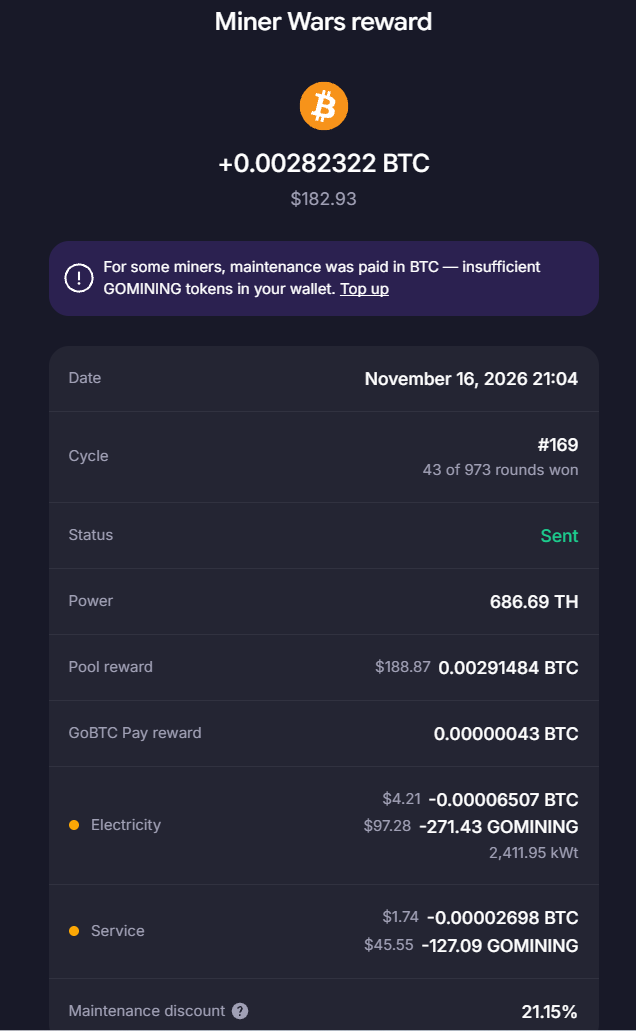
During Cycle 169, I earned a pool reward of 291,484 satoshis with 686.69 TH of mining power.
I didn’t have enough GOMINING tokens available in my wallet to cover all of my maintenance expenses, so some of those expenses were covered using Bitcoin instead.
Even with that additional Bitcoin deduction, I finished the cycle with a payout of 282,322 satoshis, valued at approximately US$182.93 at the applicable valuation.
What I find particularly interesting about this cycle is that I didn’t encounter a Reward Protection warning. My additional Bitcoin rewards were still contributing to my payout after the applicable maintenance expenses.
That’s what I want to see when we’re competing for additional blocks. I want the Bitcoin we’re earning beyond our Mining Mode threshold to contribute something meaningful to our final payout.
Of course, I still need to account for my personal GOMINING rewards and boosting expenses before determining whether the entire cycle was more profitable than Mining Mode.
Cycle 170: Entering the Reward Protection Risk Zone
Now, here’s where things started to get uncomfortable for me.
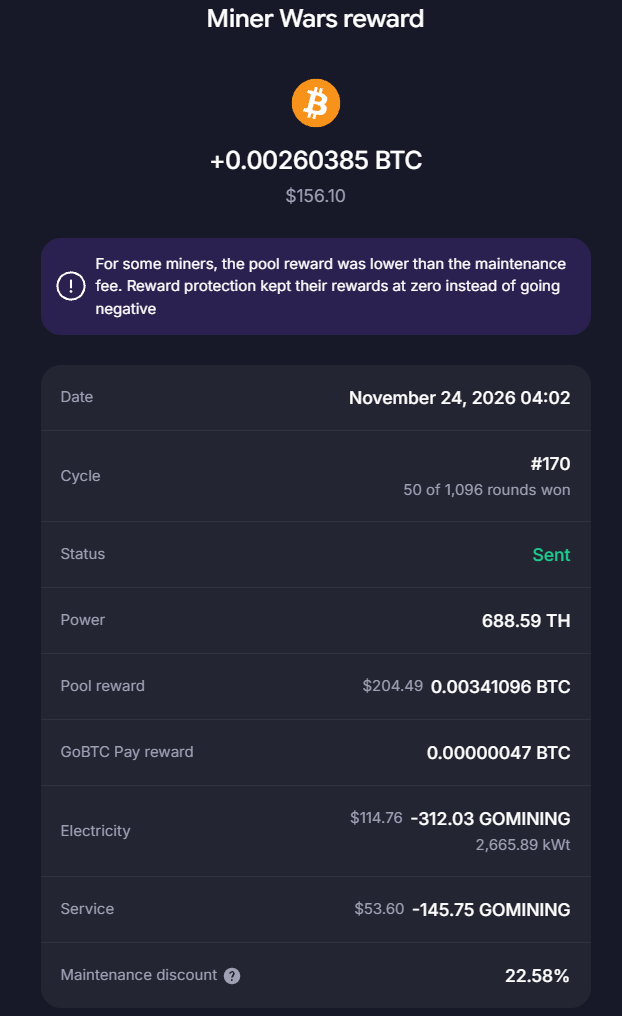
During Cycle 170, my pool reward increased to 341,096 satoshis with 688.59 TH of mining power. Naturally, I was excited about earning more Bitcoin.
But my final payout was only 260,385 satoshis, valued at approximately US$156.10. Despite earning a considerably higher pool reward, I actually received less Bitcoin than I did during Cycle 169.
And there it was. Reward Protection!
When the applicable maintenance expenses would exceed the Bitcoin reward from a block, Reward Protection prevents a negative Bitcoin payout. We can still retain personal GOMINING token rewards from qualifying wins, but that doesn’t necessarily mean the additional boosting expenses were worthwhile.
Cycle 170 pushed us much closer to the risk zone, where additional boosting became harder to justify financially.
That’s when I started looking much closer at the league’s efficiency, maintenance discounts and the current price of Bitcoin.
More Bitcoin Won, Less Bitcoin Received
| Reward comparison | Cycle 169 | Cycle 170 |
|---|---|---|
| Mining power | 686.69 TH | 688.59 TH |
| Pool reward | 291,484 sats | 341,096 sats |
| Final BTC payout | 282,322 sats | 260,385 sats |
| Reward Protection warning | Not displayed | Displayed |
Think about those numbers for a minute. My pool reward increased by approximately 17%, yet my final Bitcoin payout decreased by approximately 7.8%.
That’s a significant difference, and it’s exactly why I don’t want us relying exclusively on the amount of Bitcoin we’re earning on the leaderboard.
But here’s the part that really bothers me. We’re spending GOMINING tokens trying to win additional blocks. If those blocks aren’t contributing any Bitcoin to our payout, we’re relying on the value of our personal token rewards to justify that spending.
What if we spent more tokens winning the block than we earned from it?
I wasn’t the only member of our clan experiencing Reward Protection either. After reviewing another member’s results, I knew this was something we needed to spend more time investigating together.
I’m continuing to reconcile our historical payments, including the different maintenance payment methods, so we can understand exactly how these rewards are calculated. I don’t want to guess. I want us to understand where our money is going.
Has GoMining Created a Miner Wars Graveyard?
All right, let’s talk about those rusty old miners on today’s thumbnail!
Imagine spending money upgrading your mining farm from 20 W/TH to 15 W/TH. Then, as your operation grows, you invest even more money to improve your efficiency to 12 W/TH.
Why are you making those investments? Because you want to reduce your electricity expenses and keep more of the Bitcoin you’re earning.
Now put yourself in a Miner Wars league alongside several very large mining farms operating at 18 W/TH, 20 W/TH or higher.
Their mining power contributes to the league’s weighted average efficiency. Depending on the composition of that league, your excess Bitcoin rewards could become subject to significantly worse maintenance conditions than those you’ve worked to achieve.
Meanwhile, those less efficient mining farms can still compete for personal GOMINING token rewards.
Why should I spend money improving my mining efficiency only to have someone else’s inefficiency affect how much Bitcoin I get to keep?
That’s the heart of my frustration with Miner Wars right now.
I also find myself wondering whether this reward structure was designed, in part, to give owners of less efficient equipment another way to remain competitive when Mining Mode becomes less attractive for them.
Perhaps GoMining is trying to accommodate those users and avoid dissatisfaction among owners of older mining farms. That’s my own theory. I don’t know whether that’s actually the company’s reasoning, but I would love to hear its perspective.
I’m not blaming individual miners for using the opportunities available to them. If the rules allow them to compete for rewards, of course they’re going to consider doing so.
I’m questioning the rules themselves. Are we rewarding inefficiency while reducing the benefits for people who have invested in becoming more efficient?
That’s what I’m calling the Miner Wars Graveyard, and I think it’s a conversation worth having.
How Could GoMining Make Miner Wars Fairer?
I don’t want to spend all this time complaining about something without offering a few ideas that might actually improve it.
What if we introduced efficiency requirements for different Miner Wars leagues? What if we created opportunities for less efficient miners to continue competing without compromising the maintenance conditions of more efficient mining farms?
I’ve got a few ideas that I genuinely believe are worth discussing.
- Introduce maximum W/TH requirements for participation in certain Miner Wars leagues.
- Separate competitors into leagues based on mining efficiency.
- Reconsider how league average maintenance conditions are applied to excess rewards.
- Provide clearer information about potential profitability before users spend tokens competing for additional blocks.
- Make Reward Protection and final Bitcoin reward calculations easier for miners to understand.
For example, could we have one competition for miners operating at 15 W/TH or better and another competition for miners operating at higher W/TH ratings?
I’m not suggesting that we have all the answers. These are ideas for improving the existing system, not changes GoMining has announced.
I would love to get more clan owners involved in this conversation. We all want Miner Wars to be enjoyable, competitive and financially worthwhile.
Four Variables That Influence Miner Wars Profitability
Now that we’ve identified the problem, how do we start working toward a solution?
I’ve been spending a lot of time working with our historical mining data, and there are four variables I want us to pay particularly close attention to when evaluating GoMining Miner Wars profitability.
1. Bitcoin Price
The price of Bitcoin has a significant impact on how much of our mining income we get to keep.
When Bitcoin drops in value, our electricity and service expenses don’t necessarily drop with it. We may need a greater proportion of our Bitcoin earnings just to cover maintenance.
A boosting strategy that made financial sense yesterday might not make financial sense today. That’s why I don’t want to rely on a fixed strategy that ignores changing market conditions.
2. GOMINING Token Price
We spend GOMINING tokens to compete in Miner Wars, and we earn GOMINING tokens through personal block victories.
It’s easy to look at a spell costing a certain number of tokens without stopping to think about its actual dollar value.
Those tokens are money. Whether I purchased them through an exchange, earned them through governance or received them from personal block wins, they have value.
I want to make sure that when we’re spending them, we understand what we’re getting in return.
3. League Average Mining Efficiency
Mining efficiency is measured in watts per terahash, or W/TH. The lower that number, the less electricity we need to produce the same amount of mining power.
Rather than limiting our comparison to a 100 TH mining farm, I’ve developed an interactive tool that allows you to explore your own mining operation and compare your maintenance conditions against your Miner Wars league.
NFTMiner.ca Efficiency Analyzer
Open the Efficiency Analyzer in a separate tab
Try adjusting your individual mining efficiency, maintenance discount and league averages. A negative maintenance cost difference represents potential savings, while a positive difference represents additional modeled expenses. Remember that these are comparable maintenance scenarios, not actual Miner Wars settlement calculations.
An 18 W/TH miner requires 50% more electricity than a 12 W/TH miner producing the same hashrate. At 20 W/TH, that difference increases to approximately 66.7%.
That’s a significant difference!
Now imagine how much influence large mining farms operating at those efficiencies could have on a league’s weighted average.
4. League Average Maintenance Discount
If you’ve been following NFTMiner.ca for a while, you know how much time I’ve invested in understanding GoMining maintenance discounts.
I’ve tested different maintenance payment methods, built governance locks and worked toward a mining operation that can help fund its own expenses.
But if my individual maintenance discount is significantly better than the league average, I need to understand how much of that advantage I’m giving up when excess rewards become subject to league conditions.
Comparing the League Averages from Cycles 169 and 170
Remember those two Bitcoin payouts I shared earlier? Let’s take a closer look at the leagues we were competing in and the maintenance conditions associated with those leagues.
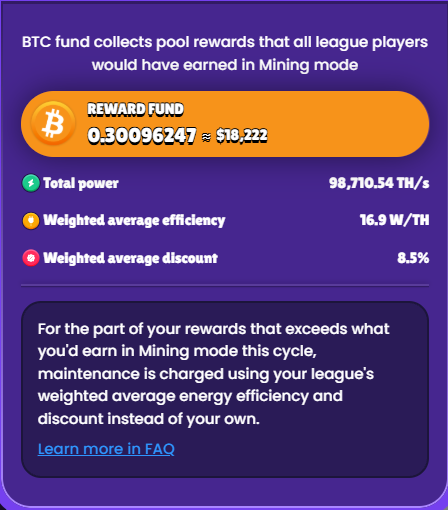
Weighted average efficiency: 16.9 W/TH.
Weighted average maintenance discount: 8.5%.
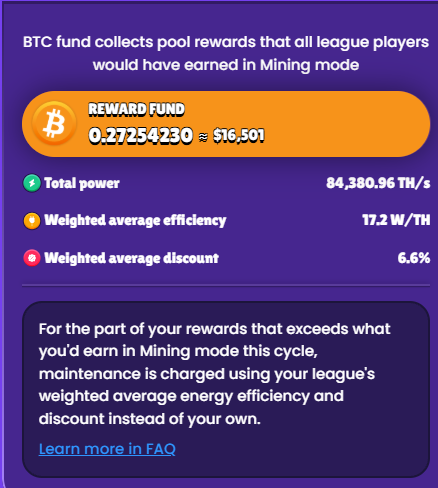
Weighted average efficiency: 17.2 W/TH.
Weighted average maintenance discount: 6.6%.
What I really want you to pay attention to is the explanation GoMining provides underneath the league statistics. Once our rewards exceed what we would have earned in Mining Mode for that cycle, maintenance on those excess rewards is calculated using the league’s weighted average energy efficiency and discount instead of our own.
| Comparison | Cycle 169 | Cycle 170 |
|---|---|---|
| League | Horizon VII | Horizon III |
| Displayed league power | 98,710.54 TH | 84,380.96 TH |
| Displayed league efficiency | 16.9 W/TH | 17.2 W/TH |
| Displayed league discount | 8.5% | 6.6% |
| My personal maintenance discount | 21.15% | 22.58% |
| My pool reward | 291,484 sats | 341,096 sats |
| My final Bitcoin payout | 282,322 sats | 260,385 sats |
| Reward Protection warning | Not displayed | Displayed |
Look at the difference between my personal maintenance discounts and those league averages! During Cycle 170, my personal maintenance discount was 22.58%. The league information shows a weighted average discount of only 6.6%.
That’s a difference of 15.98 percentage points. If those league conditions were applied to my excess rewards, a considerable portion of the maintenance advantage I’ve worked to achieve would no longer apply to that additional Bitcoin.
We also need to consider the price of Bitcoin, the difference in efficiency and the way maintenance was paid during each cycle. These screenshots help illustrate the problem, although they don’t establish exactly how much each variable contributed to my final payout.
Put these four variables together and you can start to see why I’ve become so interested in developing a better way to evaluate Miner Wars profitability.
Cycle 171: More Bitcoin Does Not Guarantee More Profit
Let’s take a look at what we’re accomplishing right now with NFT Miner CA in Horizon IX.
As of November 26, we’re approximately 38% of the way through Cycle 171. We’ve already won 68 blocks, and our reported Bitcoin rewards are approximately 45% higher than our interim solo benchmark.
That’s an exciting start to the cycle, especially with 13 members working together!
| Cycle 171 metric | November 26 results |
|---|---|
| Clan members | 13 |
| Clan mining power | 3,798.17 TH |
| Cycle completion | 38.0% |
| Blocks won | 68 |
| Solo benchmark rate | 47 sats/TH/day |
| Estimated solo BTC to date | 0.00452988 BTC |
| Reported Miner Wars BTC | 0.00656734 BTC |
| Gross BTC advantage | Approximately 45.0% |
| Boost activations | 290 |
| Estimated personal token rewards | 350.14 GOM |
| Estimated boosting costs | 388.99 GOM |
| Estimated advantage versus solo, after boosts and before maintenance | +$109.23 USD |
We’ve earned an estimated 350.14 GOMINING tokens through personal victories, but we’ve spent approximately 388.99 tokens on boosting.
That means some of our additional Bitcoin earnings need to cover the difference. So far, our comparison looks encouraging, but we haven’t yet accounted for the final maintenance expenses.
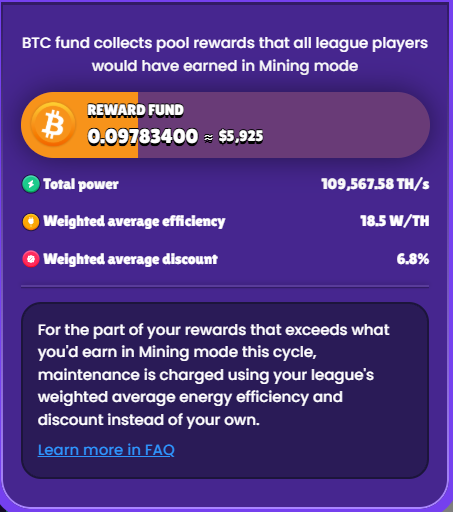
Weighted average efficiency: 18.5 W/TH.
Weighted average maintenance discount: 6.8%.
November 26, 2026.
Here’s where things get interesting. Our latest Horizon IX league information shows approximately 18.5 W/TH weighted average efficiency and a 6.8% weighted average maintenance discount.
Would I deliberately purchase an 18.5 W/TH miner for my own mining operation? No. So why wouldn’t I be concerned about those conditions being applied to my excess rewards?
My own mining efficiency is approximately 14.97 W/TH. At an equivalent amount of mining power, 18.5 W/TH requires approximately 23.6% more electricity. That’s something I absolutely want to consider before spending more GOMINING tokens competing for excess Bitcoin rewards.
And this is exactly where I want us to start changing our approach. Instead of waiting until the cycle is over and discovering that Reward Protection affected our earnings, let’s start monitoring these conditions while we’re still competing.
We’re already outperforming our interim solo benchmark, but that doesn’t mean we’ve secured a final profit or reached our full-cycle Mining Mode threshold. I want us to consider the current league averages, Bitcoin price and potential personal token rewards before committing to another paid boosting campaign.
These league averages can change throughout the cycle. That’s why we’re developing tools that allow us to reassess our financial position as new information becomes available.
My Individual Miner Wars Results
I’m also keeping a close eye on my own performance. I want to make sure that the strategies I’m encouraging our clan members to consider are strategies I’m prepared to follow myself.
| My mining operation | Cycle 171 results |
|---|---|
| Mining power | 690.72 TH |
| Mining efficiency | 14.97 W/TH |
| Personal blocks won | 11 |
| Estimated solo reward | 86,353 sats |
| Estimated Miner Wars allocation | 125,193 sats |
| Estimated GOMINING rewards | 56.64 GOM |
| Estimated boosting expenses | 26.60 GOM |
| Estimated token surplus | 30.04 GOM |
| Estimated advantage versus solo before maintenance | +$34.57 USD |
I’m happy with the progress I’ve made so far. But I don’t want to take that $34.57 advantage and start spending it as though it’s already sitting in my wallet.
I want to protect that advantage and make sensible decisions throughout the remainder of the cycle.
When Should We Stop Spending GOMINING Tokens?
This is one of the biggest changes I want to introduce to our clan.
Instead of boosting simply because we have an opportunity to win another block, I want us to consider whether winning that block is financially worthwhile.
What if we’re approaching our full-cycle Mining Mode earnings threshold and the current Bitcoin price, league efficiency and league maintenance discount suggest our excess Bitcoin rewards could be unprofitable?
Do we really want to keep spending GOMINING tokens under those conditions?
We could take a more passive approach. Allow our mining power to continue participating in Miner Wars while protecting the financial progress we’ve already made.
There may still be opportunities where the potential personal GOMINING rewards justify additional spending. That’s something we need to evaluate rather than assume.
Our Profitability Comparison
Miner Wars net income = BTC reward value + personal GOMINING reward value − applicable maintenance expenses − boosting costs.
Mining Mode net income = comparable BTC reward value − applicable maintenance expenses.
Miner Wars advantage = Miner Wars net income − Mining Mode net income.
When we’re working with final Bitcoin payouts, we need to be careful not to deduct maintenance expenses that have already been taken out of those rewards. Consistency is important if we want our comparisons to mean anything.
NFTMiner.ca Miner Wars Profitability Simulator
I’m excited to share the first public version of our Miner Wars Profitability Simulator! I’ve designed this tool around the four variables we’ve been discussing throughout this article: Bitcoin price, GOMINING token price, league weighted average mining efficiency and league weighted average maintenance discounts.
You can also enter your full-cycle gross Mining Mode threshold and accumulated gross Miner Wars rewards to help put your potential excess reward risk into perspective.
Open the Miner Wars Profitability Simulator in a separate tab
I’ve included league presets from Cycles 169, 170 and 171 so you can explore how different league conditions influence the estimated break-even price of Bitcoin on excess rewards.
Our historical research has helped establish a preliminary model for evaluating excess reward risk. However, we’re still validating its forecasting accuracy. This simulator is intended to help you explore financial conditions, not predict individual block victories, guarantee profitability or determine exactly when Reward Protection will occur.
Our goal is to develop a strategy that helps us understand when to boost, when to reassess and when it might be better to sit back and allow our miners to do the work.
Profitability first. Boosting second.
Fairness, Participation and Roundtable Rewards
Fairness is incredibly important to me, especially when we’re asking people to work together and spend their own money.
Not everyone in our clan owns hundreds of terahash. Not everyone has the same mining efficiency, VIP benefits or maintenance discounts.
Why would I expect someone with a smaller mining farm to spend tokens simply because someone with a much larger mining farm is in a position to do so?
I’ve made it clear that I want our members to establish a financial advantage before they’re expected to participate in coordinated paid boosting campaigns.
That’s also why I enjoy what we’re building with our NFT Miner CA Roundtable. We have an opportunity to recognize the members who contribute financially to our coordinated campaigns, with the top five qualifying boost spenders earning seats in the following cycle.
But I never want someone to jeopardize their own profitability just to earn a seat at our Roundtable.
We can reward participation, celebrate personal wins and still respect everyone’s individual financial circumstances.
We’re currently recruiting miners with 1,000 TH or less, mining efficiency of 15 W/TH or better, and a willingness to communicate through Discord.
If that sounds like the kind of community you’d enjoy being part of, come check out our NFT Miner CA clan!
Our New Miner Wars Profitability Forecasting Tools
Now, this is where things get really exciting!
What if we could determine whether it’s financially worthwhile to keep boosting before spending another GOMINING token?
I’ve been going through historical mining results, comparing our rewards, working with spreadsheets and developing a model that brings these different variables together.
I’ve put approximately four hours into today’s content and research alone. There’s a lot of work happening behind the scenes, but I genuinely enjoy it because we’re trying to solve a problem that extends well beyond our own clan.
I want to create tools that allow you to explore your potential GoMining Miner Wars profitability by changing the conditions that affect your mining operation.
- Bitcoin and GOMINING token prices.
- Your individual mining power and efficiency.
- Your applicable maintenance discounts.
- The league’s average mining efficiency and maintenance discounts.
- Expected Bitcoin and personal token rewards.
- Estimated boosting expenses.
- Potential break-even prices and profitability under different scenarios.
Imagine being able to adjust those numbers and immediately see how a change in the market or league conditions could affect your decision to continue boosting.
Our initial historical testing has been encouraging. I’m still working through the calculations and validating additional results before I make any definitive claims about the accuracy of our model.
Being able to reproduce historical results doesn’t mean we can predict every future block victory. But having a better understanding of the financial conditions we’re competing under could be incredibly valuable.
That’s what I want to accomplish.
Building the NFTMiner.ca Mining Intelligence Platform
If you’ve been following our clan tracker since we started building it, you’ve probably noticed how much it’s changed.
What began as a way to track our clan performance has grown into something much bigger. We’re monitoring individual results, personal token rewards, boost spending, historical comparisons and Roundtable participation.
We’ve also made some important changes to our public mobile and desktop dashboards. I’ve replaced other members’ usernames with permanent public member identifiers so we can continue sharing our results while respecting their privacy.
Now I want to start bringing more of these resources directly to NFTMiner.ca.
Imagine having access to Bitcoin mining calculators, AI Miner calculators, governance lock calculations and Miner Wars profitability tools all in one place.
And here’s something that’s really important to me. You don’t need to be a member of NFT Miner CA to benefit from what we’re building.
If you’re managing another clan, participating in Miner Wars or simply trying to decide whether it’s worthwhile to leave Mining Mode, I want you to be able to use these resources.
We’ve got a busy day ahead of us, and I’m hoping to share our next major development update on November 27. We’re still building and testing the new Miner Wars calculators, but I’m excited about where this is going!
Our AI Miner Calculator and Community Updates
We’ve been doing a lot more than just Miner Wars research this week.
Yesterday, I published my review of GoMining’s new AI Miners. I haven’t purchased one yet because I still have questions about the underlying service agreement and how long we’re actually entitled to use that computing power.
The buyer contracts I examined were three years long, but that doesn’t necessarily establish the duration of the underlying AI Miner service itself.
Rather than leaving everyone guessing about the potential returns, we built an interactive calculator that allows you to explore different contract scenarios, maintenance expenses and hypothetical earnings.
I’m really pleased with how it turned out. You can explore it yourself through my GoMining AI Miner review and interactive calculator.
I’ve also created a dedicated AI mining channel in our Discord community. I want us to have somewhere to share what we’re learning, ask questions and discuss new developments together.
Making the Most of Our GoMining Referral Benefits
If you’re one of my GoMining referrals, please make sure you’re familiar with the benefits available to you.
Depending on your eligibility, those benefits include bonus mining power on your first purchase, a free month of Platinum+ VIP and a 1.2 times multiplier on your Simple Earn APR.
And please don’t forget about my e-book!
If you’ve connected through my referral code and completed a qualifying purchase, reach out to me with your referral ID. Once I’ve confirmed your connection, I’ll send you a free copy of Maximizing Your GoMining Investment.
I’ve put a lot of what I’ve learned about GoMining into those 23 pages. I want you to have an opportunity to benefit from that experience.
If you’re not one of my referrals, you can still purchase a copy for US$5. Every purchase helps support the work we’re doing here at NFTMiner.ca.
Thank You for Supporting NFTMiner.ca
I also want to take a moment to thank everyone who’s been supporting the channel, sharing our content, participating in the Creator Club and joining our community discussions.
We’re not always going to agree on everything, and that’s absolutely fine. I enjoy hearing different perspectives, especially when they encourage me to investigate something I might have overlooked.
It takes time to record the videos, develop these spreadsheets, write the articles and build new resources. Knowing that people are finding value in what we’re doing makes that effort worthwhile.
Thank you for being part of it!
Frequently Asked Questions About Miner Wars Profitability
Is Miner Wars more profitable than Mining Mode?
It can be, but we need to look at our complete financial results. Bitcoin rewards, personal GOMINING rewards, maintenance expenses and boosting costs all matter. Winning more blocks doesn’t automatically mean we’re making more money.
What are excess rewards in GoMining Miner Wars?
Excess rewards are the portion of our Miner Wars Bitcoin rewards beyond the applicable Mining Mode earnings threshold. These rewards are subject to league-weighted maintenance conditions rather than our own individual maintenance conditions.
Can inefficient miners affect my Miner Wars profitability?
Yes. Because the league’s weighted average efficiency influences maintenance on excess rewards, less efficient mining power can contribute to less favorable conditions. The actual financial impact depends on the league composition, discounts, reward calculations and market prices.
What does Reward Protection do?
Reward Protection prevents a negative Bitcoin payout on applicable blocks when maintenance expenses would otherwise exceed the reward. It’s important to remember that it doesn’t reimburse the GOMINING tokens we’ve spent trying to win those blocks.
Should I stop boosting after reaching my solo benchmark?
That’s when I want us to start asking more questions. Consider the full-cycle Mining Mode threshold, current market prices, league maintenance conditions, potential personal rewards and the cost of additional boosts. Reaching our interim solo benchmark alone doesn’t determine whether we should continue spending.
Can a calculator predict my Miner Wars earnings?
A calculator can help us explore potential financial outcomes under different conditions. It cannot guarantee future market prices, personal block wins or final earnings. What I’m building is a tool to help us make better decisions with the information available to us.
Watch My Complete Miner Wars Graveyard Discussion
I know I’ve been particularly passionate about this subject, but I genuinely believe it’s one of the most important conversations I’ve had on the channel.
We’ve identified a problem, we’re learning more about it, and we’re putting in the work to develop resources that could help the entire GoMining community.
I’d love to hear from other clan owners and Miner Wars participants. Are you experiencing Reward Protection? Are you comparing your results against Mining Mode after accounting for your expenses? Do you think the current reward structure is fair to efficient miners?
Come watch the full discussion, share your thoughts and let’s see what we can accomplish together.
And remember, we’re here to mine Bitcoin and make money. Winning blocks should help us accomplish that goal, not distract us from it!
Disclosure: I’m a GoMining ambassador and may receive referral commissions. I share my own experiences, research and opinions. Interim mining results and hypothetical forecasts are not guaranteed returns. The Miner Wars Graveyard is my personal criticism of the reward structure, not an allegation of wrongdoing by individual miners.

Explore My GoMining E-Book
Maximizing Your GoMining Investment
My beginner-friendly guide to rewards, maintenance and mining strategy, built from my own GoMining experience.
E-Book Price: US$5
Bitcoin, USDT, USDC or GOMINING. Visit the payment page for the wallet address, network and delivery instructions.

About NFTMiner.ca
I’m Brian, founder of NFTMiner.ca and a GoMining ambassador. I share my mining experience, Miner Wars results and the strategies I’m exploring with our clan.
Have a question or want to follow along? Come connect!